
The Capitalism, Reproduction & Democracy Lab aims to advance a systematic understanding of contemporary capitalism by foregrounding the intertwined crises that affect the ecological, social, and political conditions for the reproduction of human life. In a context marked by the intensification of the climate crisis, rising social inequalities, and growing threats to various forms of representative democracy, the Lab analyzes contemporary capitalism both as a system of wealth production and distribution and as a framework for organizing and governing socio-ecological reproduction.
NEWS >>
 luglio 2026, Dalle contaminazioni industriali alla crisi della riproduzione socio-ecologica: un’agenda di ricerca sui Siti di Interesse Nazionale, in Altronovecento n.53
- The analytical perspective
The Lab adopts a critical political economy perspective, placing at its core the relationships among economic development, socio-ecological metabolism, social reproduction, public policy, and transformations in democratic institutions. From this standpoint, environmental crises, transformations in labor and welfare systems, the concentration of power associated with technological innovation, and the reorganization of governance structures are treated as interdependent dimensions of a broader crisis in the conditions of reproduction in advanced capitalist societies.
The CRD Lab:
- analyzes these processes across multiple scales (global, regional, national, and subnational) with the explicit objective of supporting socio-ecological transitions grounded in the principles of environmental justice, substantive democracy, and social sustainability;
- develops innovative, transdisciplinary analytical and interpretive frameworks by integrating insights from sociology, political ecology, democracy and public policy studies, feminist and ecofeminist perspectives, postcolonial epistemologies, and territorial analysis, with particular attention to the relationships among interests, knowledge, power, and decision-making processes. Within this perspective, the production and circulation of scientific and technical knowledge are treated as constitutive elements of the governance of contemporary crises and social conflicts;
- advances forms of public and collaborative research, emphasizing the role of local communities and social actors in both knowledge production and collective action, with a strong focus on participatory research strategies, co-research practices, and the production of situated knowledge, including through non-standard research methodologies.
A primary focus of analysis is areas where these crises become materially concentrated, such as contaminated industrial sites and regions undergoing industrial transition. The Lab treats these areas as empirical laboratories for investigating transformations in contemporary capitalism, illuminating the interconnections among risks to human health, environmental degradation, and the devaluation of labor, and examining emerging forms of crisis governance and their implications for democratic participation in decisions crucial to the future of our societies.
- Scientific Board
Dal Dipartimento DiSSE:
Giulio Moini, (coordinator)
Marina Ciampi,
Andrea Ciarini,
Ernesto d'Albergo,
Edoardo Esposto,
Lia Fassari,
Laura Franceschetti,
Maria Grazia Galantino,
Giorgio Giovanelli,
Tiziana Nupieri,
Giuseppe Ricotta,
Giulia Salaris,
Assunta ViterittiDa altri Atenei e Centri di Ricerca:
Davide Caselli, Università di Bergamo
Mariafrancesca D'Agostino, Università della Calabria
Stefania Ferraro, Università Sant'Orsola Benincasa
Marino Ruzzenenti, Fondazione Luigi Micheletti - Brescia
Lorenzo Viviani, Università di Pisa
- Pubblications
2026 luglio, Dalle contaminazioni industriali alla crisi della riproduzione socio-ecologica: un’agenda di ricerca sui Siti di Interesse Nazionale, in Altronovecento n.53
Activities, seminars, events
Ciclo di seminari 2026 Viverela crisi socio-ecologica. L'inquinamento territoriale nei SIN come materializzazionedei costi dello sviluppo capitalista
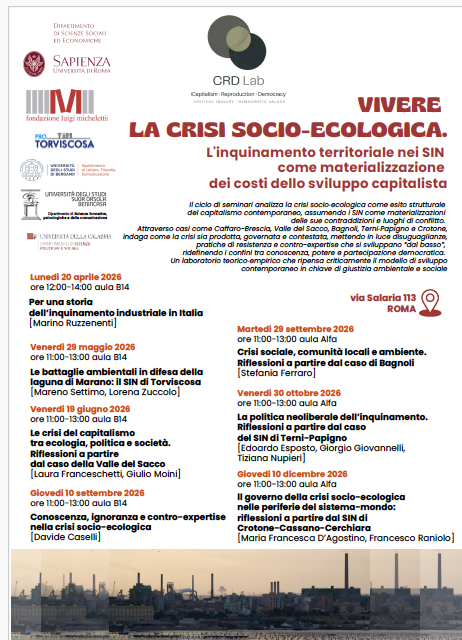
martedi 29.09.2026, ore 11:30-13:30 aula Portico (piano terra). Crisi sociale, comunità locali e ambiente. Riflessioni a partire dal caso di Bagnoli [Luciano Brancaccio, Stefania Ferraro, Emilio Gardini] - link per collegamento da remoto https://meet.google.com/xvy-fpse-rwb

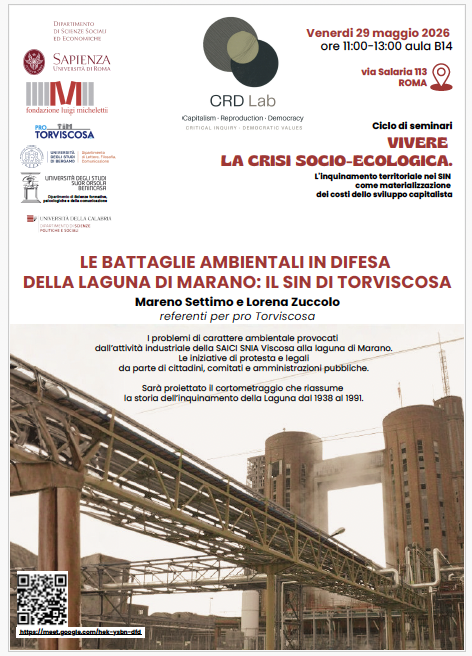
venerdi 29.05.2026, ore 11:00-13:00 aula B14 Le battaglie ambientali in difesa della Laguna di Marano: il caso del del SIN Torviscosa [Mareno Settimo, Lorena Zuccolo]
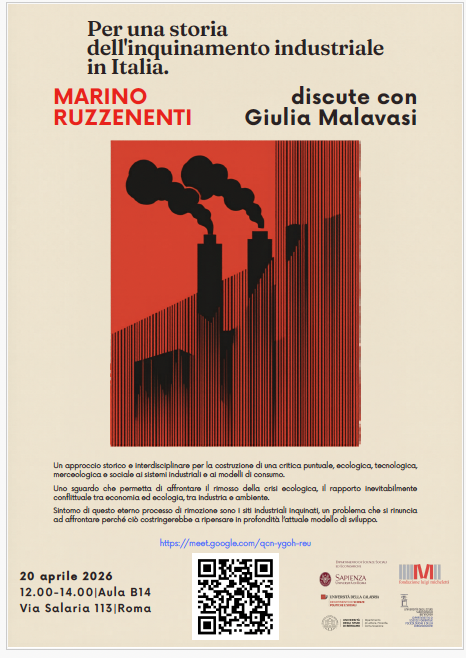
lunedi 20.04.2026, ore 12:00-14:00 aula B14, Per una storiadell’inquinamento industriale in Italia [Marino Ruzzenenti]